Offering 02 · Regulatory Health Check
Most institutions discover their compliance gaps during an examination, when the pressure is on, the timeline is imposed, and the options are limited. Whether you are a bank anticipating an OCC or Fed examination, an investment manager facing SEC scrutiny, or an exchange preparing for a FINRA review, the dynamic is the same. The AntePartners Regulatory Health Check helps identify those gaps through a targeted assessment, typically planned over 30 days for an agreed scope with the required access and information available, and delivers an actionable report card your team can execute against immediately.
Day Targeted Assessment
Actionable Output. No Shelfware.
Years of Regulatory Experience Per Expert
Zero Junior Staffing. Senior Experts Only.
The Cost of Not Knowing
The most dangerous compliance gaps are the ones you don’t know about. Regulators conduct examinations on their schedule, not yours, and by the time a finding is issued, you’re already in remediation mode with a timeline you didn’t choose, potentially at a greater cost than earlier intervention would have required.
An unresolved gap can lead to supervisory findings and, depending on its nature and severity, enforcement action. Early assessment helps leadership understand the exposure and address weaknesses before they become harder to resolve.
A process, control, or documentation weakness has not yet been identified. Addressing it early can reduce avoidable rework, delay, and disruption.
A supervisor identifies a concern requiring corrective action. The response, milestones, and evidence should reflect the specific communication and the relevant supervisory process.
Formal action can require substantial corrective work and reporting. Legal effect, disclosure, penalties, and deadlines depend on the authority, action, and circumstances; we support operational remediation alongside the bank and its counsel.
Stage 1
The AntePartners Health Check intervenes here →
What You Gain
The Health Check is not a gap list. It is a complete, prioritized, and actionable picture of your compliance posture, with clear ownership, timelines, and remediation guidance built in from day one.
01
A structured assessment across the agreed regulatory domains, including governance, controls, documentation, processes, technology, and reporting, evaluated against applicable obligations and relevant supervisory guidance.
02
Every gap is assessed by severity, regulatory exposure, and remediation complexity, giving your team a clear, ranked view of where to focus first, what can be addressed quickly, and what requires longer-term structural change.
03
The primary deliverable is a clean, executive-ready report card: a domain-by-domain rating of your compliance posture with specific, practical remediation recommendations your team can begin executing immediately after engagement close.
04
Our assessment draws on firsthand examination experience. We review relevant evidence and operating practices to identify gaps and help the institution prepare for supervisory review. The regulator conducts its own assessment and may identify additional concerns.
05
Where gaps exist, we don't just identify them. We provide the remediation path. Each finding is accompanied by a practical, resource-aware recommendation with indicative timelines so your team knows exactly what "fixed" looks like.
06
The frameworks, checklists, and assessment criteria we use during the engagement are transferred to your team at close, so you can re-run elements of the assessment independently as your environment evolves.
When you identify and remediate gaps proactively, you engage with regulators from a position of strength, demonstrating a culture of compliance rather than reacting to findings.
Regulatory remediation under an examiner-imposed timeline consumes enormous executive time. Prevention preserves the bandwidth your leadership team needs to run the business.
Addressing gaps early can reduce avoidable remediation cost and management disruption. Priorities should reflect the severity of each issue, the institution’s exposure, and the work needed to resolve it. If your institution has already received a finding, our regulatory remediation supports comprehensive resolution.
Regulatory scrutiny intensifies at inflection points: new products, new markets, M&A activity, rapid growth. A clean compliance posture enables strategic initiatives instead of blocking them.
The report card provides your board with a clear, credible, independent view of the institution’s compliance posture, fulfilling governance obligations and enabling informed oversight.
The Health Check creates a documented compliance baseline, valuable not just for the current assessment but as a reference point for measuring improvement over time.
Why Traditional Approaches Fall Short
Internal compliance functions are stretched, audit cycles are infrequent, and regulatory expectations evolve faster than most teams can track. The result is a persistent blind spot.
Compliance teams assess against internal policies, not the evolving standards regulators actually apply during examinations. The gap between the two is where findings originate.
Regulatory environments change faster than annual cycles accommodate. A compliant posture in January can develop meaningful gaps by October without any deliberate change.
Growth initiatives consistently introduce compliance obligations that the compliance function learns about after the fact, creating structural gaps from day one.
Policies and procedures frequently describe a process as it was designed, not as it is actually executed. Regulators examine both, and the delta between the two is a reliable source of findings.
Compliance reporting to the board is typically produced by the compliance function itself, without the independent external calibration needed for genuine assurance.
Our assessors have operated within regulatory environments and understand how examiners actually evaluate institutions, applying those standards, not internal policy benchmarks.
A 30-day engagement captures your compliance posture as it exists today, assessed against the regulatory expectations in effect today, not last year’s guidance.
Our assessment scope is designed to include the compliance implications of recent strategic initiatives, including new products, markets, technology changes, or organizational shifts.
We assess how processes actually operate, through interviews, observations, and transaction testing, not just whether the policy documentation says the right things.
The report card provides leadership with a credible, independent assessment they can act on with confidence, separate from the compliance function’s own reporting.
The Engagement
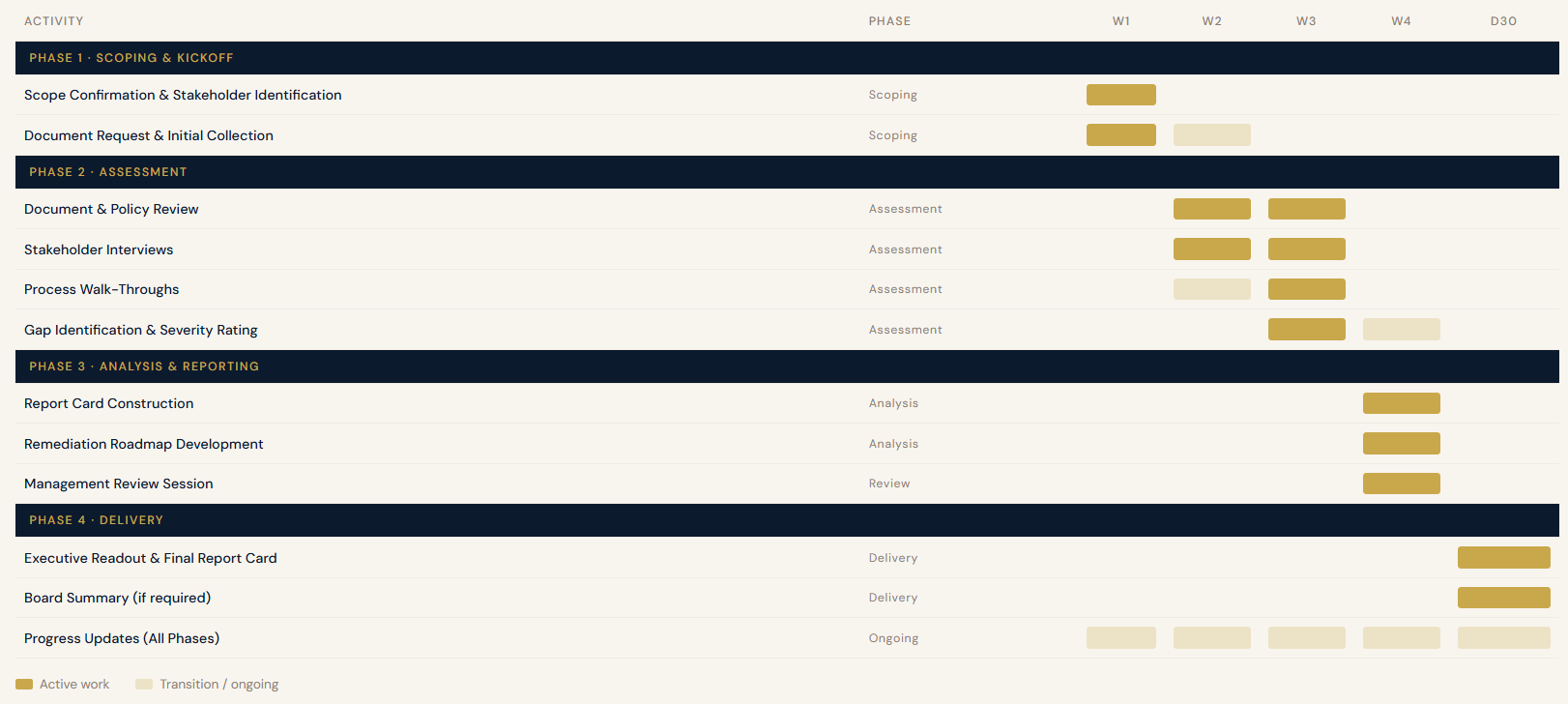
A focused, structured assessment designed to minimize disruption to your team while delivering maximum insight. Senior-led throughout, with clear milestones and a final report card your organization can act on immediately. The illustrated 30-day plan assumes an agreed scope and timely access to required people and information.
Week 1
Alignment, access, and assessment design
Define the regulatory domains, business lines, and risk areas to be assessed based on your institution’s profile, recent activity, and regulatory environment.
Identify key contacts across compliance, risk, operations, technology, and legal, structured to minimize time burden on each individual.
Issue a targeted document request covering policies, procedures, recent audit findings, and relevant regulatory correspondence.
Week 1 Output
Confirmed scope, interview schedule, document index
Weeks 2 & 3
Interviews, process reviews & testing
Review of policies, procedures, governance documentation, and prior audit and examination findings against current regulatory expectations.
Structured interviews with compliance, risk, operations, and technology stakeholders, focused on how processes actually operate, not just what documentation describes.
Selected process walk-throughs to validate that documented controls are operating as described and identify where practice diverges from policy.
Findings catalogued, assessed for severity, and rated against examiner standards, with initial remediation thinking applied to each.
Week 3 Output
Draft findings inventory with severity ratings
Week 4
Report card build & management review
Findings organized by domain into a structured, executive-readable report card with severity ratings, remediation recommendations, and indicative timelines.
Draft findings reviewed with your compliance and risk leadership, allowing for factual corrections and context before finalization.
Recommendations refined based on management input, resource constraints, and strategic priorities, producing a roadmap your team can begin executing immediately.
Week 4 Output
Draft report card reviewed and refined with management
Day 30
Final report card & board-ready presentation
Presentation of final findings and report card to C-suite and relevant leadership, structured for decision-making, not just information sharing.
A board-ready summary version of the report card available for governance reporting or audit committee presentation.
For clients who want to move directly from assessment to remediation, AntePartners can transition seamlessly into a dedicated remediation engagement.
Day 30 Final Deliverables
Report card + remediation roadmap + board summary
Activity Schedule
Assessment Coverage
The assessment scope is tailored to your institution’s profile and regulatory environment. Typical engagements cover the following domains. Each is assessed against current examiner standards, not just internal policy.
Board and committee oversight structures, management reporting frameworks, compliance program governance, escalation procedures, and the adequacy of first, second, and third line of defense arrangements.
Currency, completeness, and regulatory alignment of key policies, assessed against both current regulatory guidance and how processes actually operate in practice, identifying gaps between documented intent and execution reality.
Completeness, accuracy, and timeliness of required regulatory filings and disclosures, including the quality of data controls, reconciliation processes, and documentation supporting reported figures.
Design and operating effectiveness of key risk controls across credit, market, operational, and compliance risk, including limit structures, breach escalation, and the adequacy of monitoring and exception reporting.
Compliance framework adequacy within specific business lines, with particular attention to areas of recent regulatory focus, new product introduction, or where prior examination findings have been issued.
Review of prior examination and internal audit findings, assessing remediation status, sustainability of corrective actions, and whether root causes have been fully addressed or are likely to recur under examiner scrutiny.
The Primary Deliverable
Not a gap list. Not a slide deck. A structured, actionable, executive-ready assessment your organization can act on from day one.
The Primary Deliverable
Illustrative example. Actual ratings reflect your institution’s assessed posture.
Governance & Oversight
Strong
Policies & Procedures
Needs Attention
Regulatory Reporting
Satisfactory
Risk Management Controls
Requires Action
Business Line Compliance
Needs Attention
Prior Finding Status
Strong
3 findings require immediate action · 2 require near-term attention
Remediation roadmap attached →
Four complementary deliverables
01
Primary Deliverable
Domain-by-domain ratings with severity classifications, specific gap descriptions, and examiner-perspective commentary. Executive-ready and board-presentable.
02
Action Plan
A prioritized, resource-aware remediation plan for each finding, with practical recommendations, indicative timelines, and clear ownership guidance.
03
Supporting Detail
Full supporting documentation for each finding, including regulatory references, evidence reviewed, and the specific corrective actions recommended.
04
Governance Tool
A concise, non-technical summary of the assessment for board or audit committee presentation, structured to support informed governance oversight.
A focused assessment with an agreed timetable. An actionable report card. A team more capable at close than at the start.
You have questions, We have Answers
The assessment covers the agreed governance, controls, documentation, processes, technology, and reporting domains. Model risk work considers applicable supervisory guidance, including SR 26-2 where relevant to the institution and its model use. The output is an executive-ready report card and actionable remediation recommendations. A 30-day target depends on the agreed scope and timely access to information.
Before an examination cycle, when entering a new regulatory tier, following a merger or acquisition, when your institution is uncertain about its compliance posture, or when you want an independent view before a regulator provides one.
Senior practitioners who have held the roles on the institutional side that regulators examine. Not analysts applying a checklist but rather executives who have navigated examination cycles, managed regulatory relationships, and sat in front of examiners at institutions of comparable size and complexity.
An executive-ready compliance report card rating your posture across all assessed domains, a prioritized remediation roadmap with specific actions and timelines, a regulatory exposure summary identifying the highest-risk gaps, and a board-ready summary suitable for the audit committee or risk committee.
Internal audit provides independent assurance under the institution’s audit mandate, including relevant controls, risks, and regulatory obligations. Our Regulatory Health Check is a separately scoped assessment that draws on examination experience to identify gaps and prioritize practical remediation. It complements the bank’s control and assurance functions; it does not replace internal audit or guarantee a supervisory outcome.
Get In Touch
Tell us about your institution and your current compliance concerns. Our team responds within one business day.
