We deploy fast. Weeks of runway lost to a slow consultant search are weeks that compound the problem. AntePartners is typically embedded within days of engagement.
Every person we deploy has led programs of this scale and type at a bank, exchange, or investment manager. There is no learning curve and no pyramid of junior resources doing the work under a senior name. This is the structural difference between AntePartners and a large consulting firm on your most critical program.
A distressed program is a regulatory risk. Our embedded approach ensures compliance obligations are addressed as part of the recovery, not discovered as a new problem after it.
Program distress is expensive. Extended timelines, rework, vendor penalties, and management distraction compound daily. A fast, focused recovery is always the lower-cost outcome.
A credible recovery narrative, backed by observable progress, is the most effective tool for rebuilding trust with boards, audit committees, and regulators.
We build acumen at every level as we work. When the engagement ends, your team has the governance frameworks, the institutional knowledge, and the capability to prevent a recurrence.
People who built the program find it difficult to objectively diagnose what is wrong with it. Political considerations shape the assessment before it begins.
A PMO framework delivered by analysts who have never run a program at this scale is governance theater. It produces artifacts but not outcomes.
The instinct is to produce a revised plan. But without understanding the actual root causes of distress, the new plan inherits the same structural weaknesses as the old one.
In a recovery under time pressure, regulatory compliance obligations are once more treated as a second-order concern. The program recovers technically but creates a new set of findings.
External help departs and the organization is left with the same underlying capability gaps that contributed to the distress in the first place.
Our assessment is conducted by people who have personally led recoveries of this type. They know what to look for, where programs hide their real problems, and how to communicate findings credibly to leadership.
We embed alongside your team and take accountability for delivery. There are no junior analysts doing the analysis under a senior partner's name.
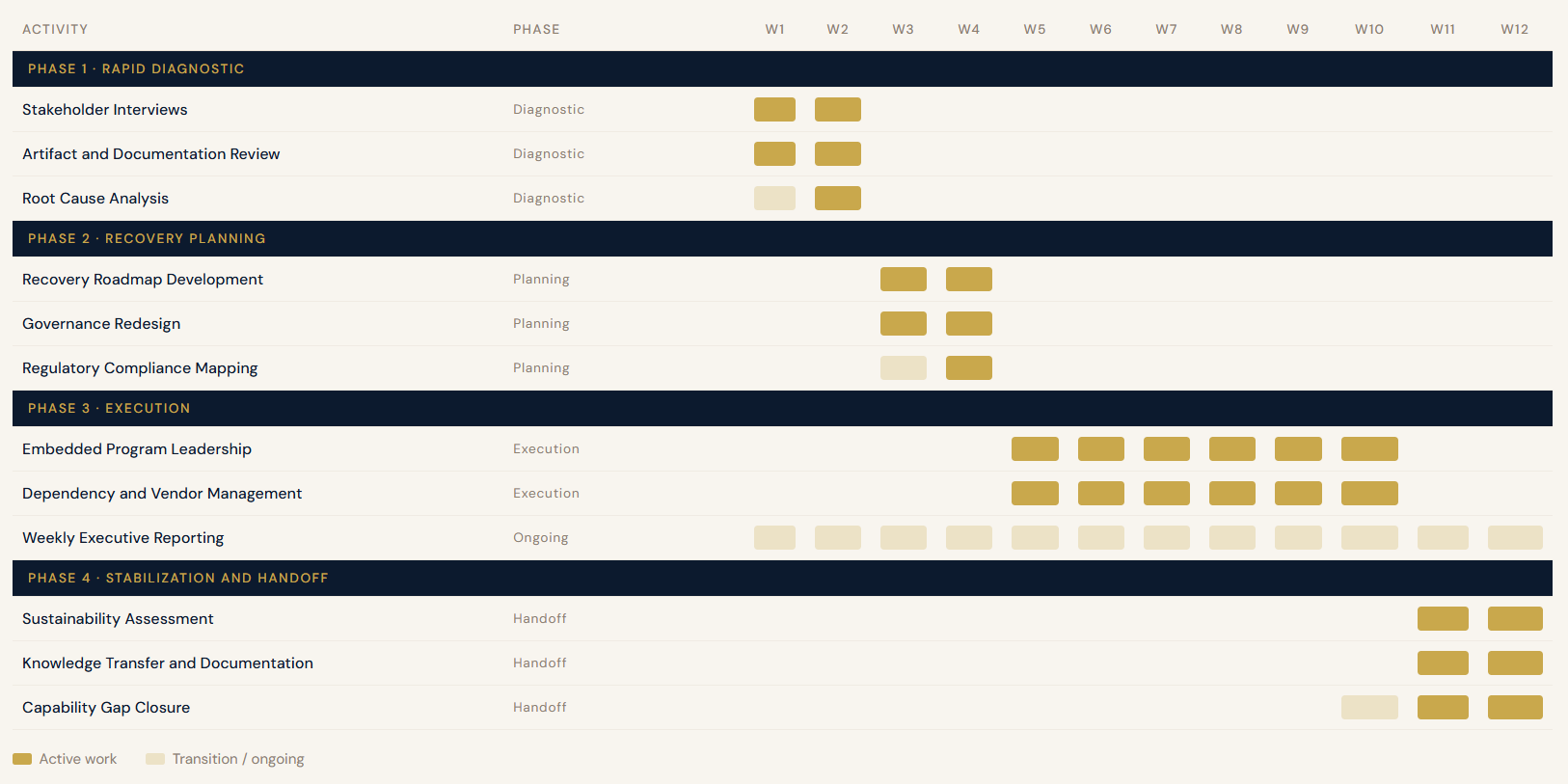
We spend the first two weeks on genuine diagnostic work before recommending a path forward. A recovery plan built on an accurate diagnosis has a fundamentally different chance of success.
Our recovery framework integrates compliance obligations throughout. Where regulatory findings exist, we bring direct MRA and enforcement action remediation experience to the engagement.
Governance frameworks, process documentation, and decision tools are built with and handed to your team as the engagement progresses, not delivered as a final document dump.
Structured conversations across all levels of the program, from working team to executive sponsor, without the filtering that typically occurs through internal reporting channels.
Assessment of the plan, risk log, issue log, decision register, and key technical outputs to identify where the documented state diverges from reality.
Identification of the structural causes of distress, not just the presenting symptoms, with a clear view of which issues are recoverable and which require fundamental reframing.
A realistic, sequenced recovery plan with clear milestones, resource requirements, and dependency mapping, built on the diagnostic findings rather than on the original plan's assumptions.
Accountability structures, decision rights, and escalation paths are clarified and documented. Where a PMO exists, its operating model is strengthened.
Compliance obligations are mapped to the recovery workstreams to ensure they are addressed as integral components, not late-stage additions.
AntePartners practitioners work directly within the program, not as observers. Blockers are cleared in real time and the recovery plan is executed with the pace the situation requires.
Third-party dependencies and vendor commitments are actively managed with the rigor that program recovery demands.
Transparent, fact-based reporting to executive sponsors and the board, calibrated to what leadership needs to make decisions, not to manage perceptions.
Before disengagement, we assess whether the program governance, team capability, and delivery rhythm are strong enough to continue without external support.
Governance frameworks, decision logs, process documentation, and lessons learned are transferred to your team in a form they can use and build on immediately.
Where skill or process gaps contributed to the original distress, we work with your team to address them directly so the organization does not face the same vulnerabilities on the next program.
The clearest signals are a program that has missed two or more milestone deadlines, a regulator or board asking questions management cannot answer confidently, a budget revised upward more than once without a clear recovery plan, or a leadership vacuum where no single person owns the outcome.
AntePartners is typically embedded within days of engagement. The first two weeks are spent on rapid diagnostic work to identify actual root causes, not a re-planning exercise.
Yes. Regulatory compliance obligations are integrated into the recovery plan from day one. Where regulatory findings or examiner concerns are a factor, AntePartners brings direct regulatory enforcement action remediation experience to the engagement.
Banks, exchanges, and investment management firms across financial services. Program distress looks different at each institution type but the underlying causes (governance gaps, unclear accountability, scope creep, and regulatory pressure) are consistent across all of them.
Four outputs: a diagnostic report with root cause findings, a recovery roadmap and governance framework, observable and measurable delivery progress with cleared blockers, and a complete knowledge transfer package including governance frameworks, process documentation, and lessons learned.
